Data shows that, 34 years in, nearby neighborhoods and businesses haven’t basked in ballpark’s glow
By Matt Cohen
A ballpark in downtown Baltimore was meant to secure the team — and also to extend the string of successful developments at the city’s core.
Oriole Park at Camden Yards has been the model for other baseball stadium projects around the country. Camden Yards, which opened in 1992, brings in tens of millions of dollars in revenue for the Orioles every year, the Maryland Stadium Authority has said.
William Donald Schaefer, then Maryland’s governor and a former Baltimore mayor, pitched Camden Yards as another major attraction for a thriving downtown. Ideally, the ballpark would build on the successes a decade earlier of Harborplace, the National Aquarium and the Baltimore Convention Center.
Instead, Harborplace steadily decayed to the point where its pavilions will be razed and replaced in coming years by a new billion-dollar mixed-use project.
While downtown development boosted the economy, those gains were eventually overwhelmed by social and economic problems that ranged from drugs to urban flight.
“What Schaefer did was mostly psychological,” Matthew Crenson, a political science professor at the Johns Hopkins University, told The New York Times in an article after Schaefer’s death in 2011. “He turned around the city’s morale, but not so much its economy.”
Economists say Camden Yards’ success, while revolutionary and productive inside its gates, hasn’t cultivated prosperity outside it. Nor could it have realistically been expected to. The central business district faces many challenges, including high vacancy rates, the heightened perception of crime, retail exodus, deteriorating infrastructure, and economic downturns.
A baseball stadium alone can’t be responsible for a city’s successes, or its failures, economists say.
According to documents provided to Capital News Service by the Maryland Stadium Authority, Camden Yards consistently produced more than $160 million in spending at the stadium and its nearby streets annually during the 2010s, but the number was down about 35% by 2021, the first season with regular attendance after the COVID-19 pandemic.
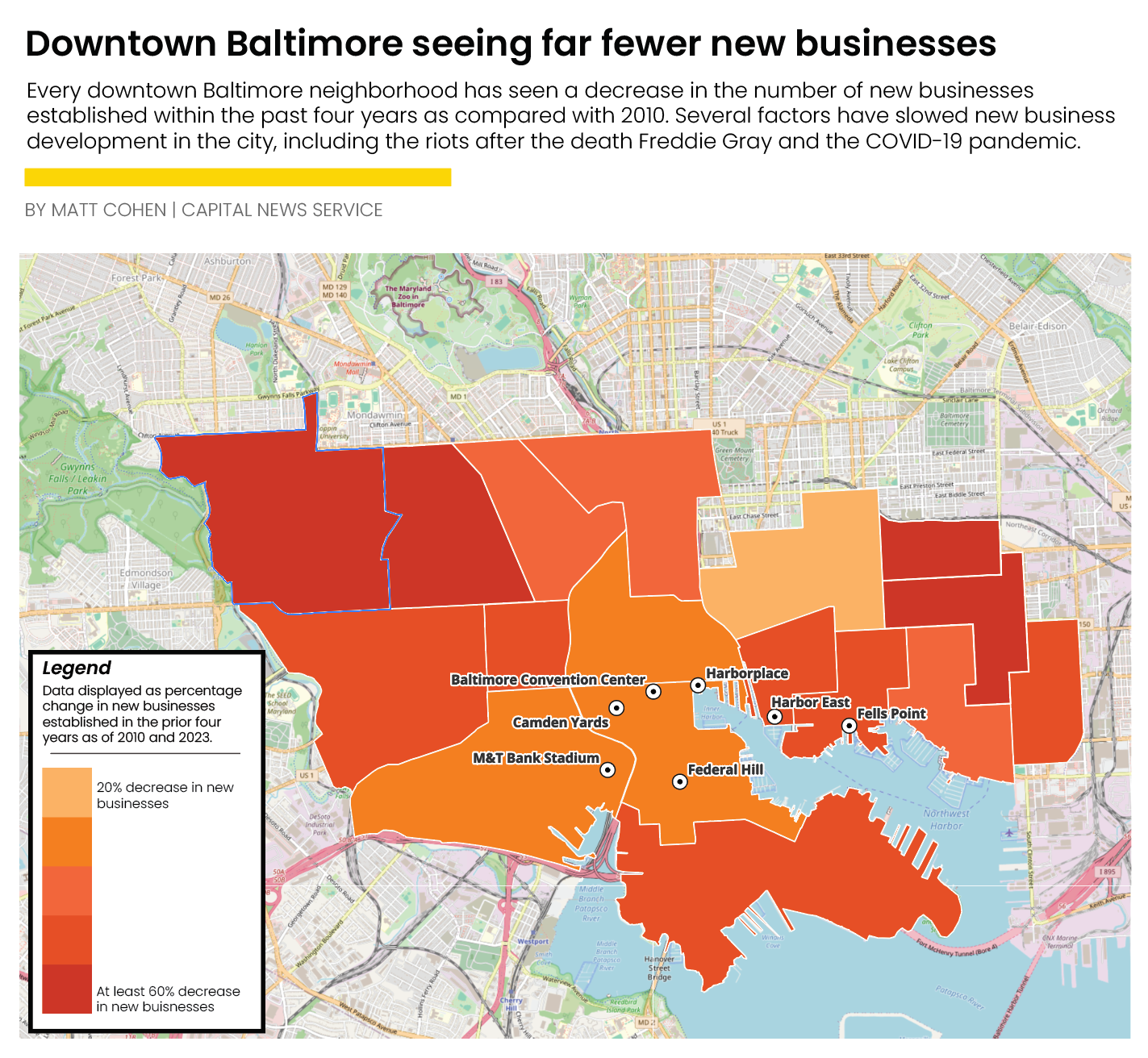
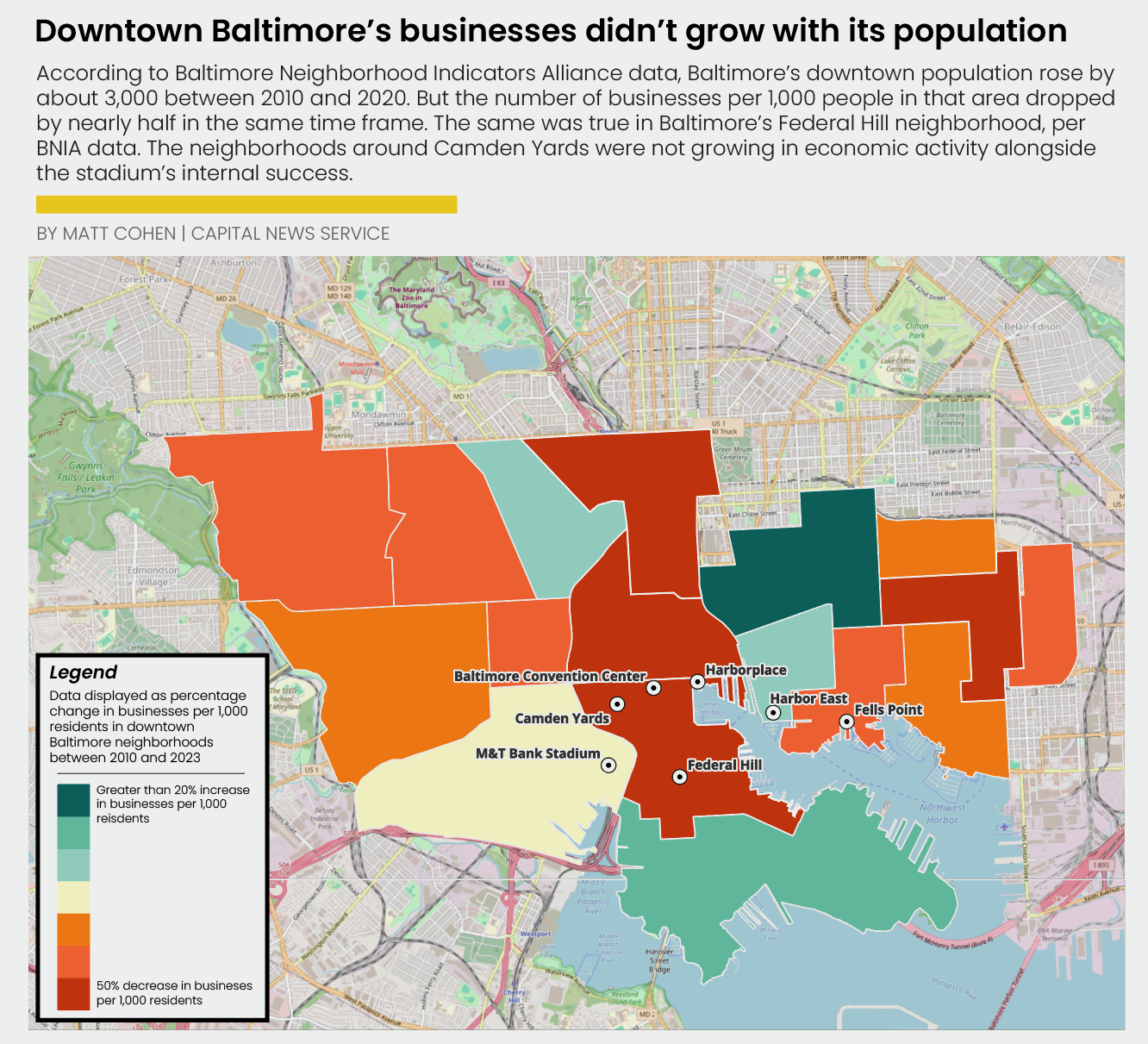
In 2025, data shows fewer businesses per capita downtown.
Economists agree that stadiums rarely offer a return on the significant investment of public funding for their construction. Cities hardly make much, if any, money from stadiums.
Camden Yards’ original construction cost $110 million, which was largely funded by state bonds. According to the MSA’s 2024 financial report, the Orioles pay an annual rent of under $10 million as well as a 10% tax on ticket revenue.
For the Orioles and Ravens combined, that ticket tax equaled $18.6 million.
Maryland has continued to approve public funding for stadium renovation since Camden Yards opened. The state approved a $135 million plan to install a new video board and sound system, among other renovations, for the 2026 season.
As part of the team’s current lease with the MSA, the Orioles will access $600 million in public funding once it secures ground leases for developments around the stadium. The team is required to have a redevelopment plan approved by the end of 2027.
But largely, economists believe stadiums are a bad use of public money. The teams “can fund it themselves,” said J.C. Bradbury, an economics professor at Kennesaw State University in Georgia, whose research focuses on stadiums. “You might argue, ‘Well, there are community benefit spillovers.’ Well, yeah, there are community benefit spillovers from nice restaurants. We don’t normally subsidize those, either.”
In early October, Baltimore Mayor Brandon Scott announced a 10-year master plan for reenergizing the city’s downtown by improving infrastructure, business opportunities and safety. It’s part of an ongoing effort that has already invested several billion dollars into Baltimore’s hub. The plan includes upgrades to the Baltimore Convention Center as well as new pedestrian walkways and gathering areas.
Scott and Maryland Gov. Wes Moore have described the project as a renaissance for downtown Baltimore. Business owners responded in a New York Times article last year that the downtown needs a full redo, not a refresh.
The Orioles, Ravens and Maryland Stadium Authority are all listed as partners on the project.
In the 2024 election, Baltimore residents overwhelmingly voted in favor of a referendum opening the path for major redevelopment of the Inner Harbor.
Including the expected $600 million to come, Camden Yards will have cost taxpayers $1.3 billion over the life of the stadium, according to a 2023 Baltimore Sun story. The Sun estimated that Maryland lost out on about $121 million worth of property taxes because the ballpark is owned by the state.
To see a benefit from the investment, “you’d have to see in the order of billions of dollars being generated in the local economy,” said Mac McComas, senior program manager of Hopkins’ 21st Century Cities Initiative. “So that would be quite a significant jump. Everybody that’s looked at it just has not seen that.”
Largely, economists say that a stadium cannibalizes the economy of the rest of the city because dollars spent at the stadium to get a ticket and a hot dog mean dollars not spent somewhere else. A stadium doesn’t add economic impact to the city, they say, but instead takes already existing activity and shifts it around.
Dennis Coates, an economics professor at University of Maryland, Baltimore County who has studied Camden Yards, said stadiums generally don’t increase jobs in the community or lead to higher salaries. The biggest thing a stadium adds, Coates said, is an "unquantified measure of happiness,” but it is hard to value that against a monetary impact.
Bradbury said there is information to show stadiums might actually hinder area development because the venues are disruptive to commerce around them.
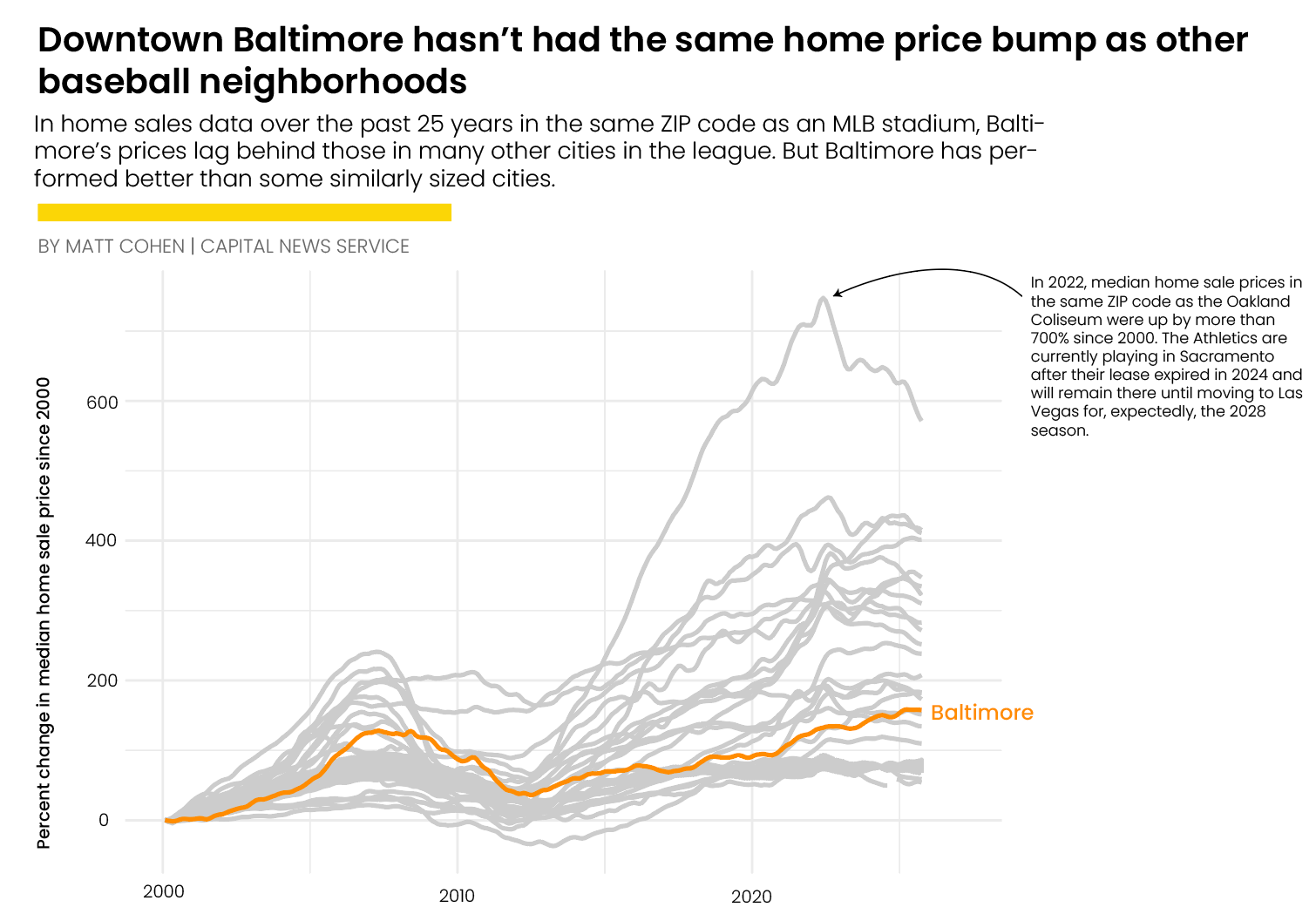
Baltimore’s stadium is adjacent to several downtown neighborhoods. But the presence of the stadium hasn’t significantly increased the home values around Camden Yards, especially relative to increasing prices in other cities with MLB venues.
Nor has the stadium sparked significant new construction around it. The already limited housing around Camden Yards, in neighborhoods like Otterbein and Ridgely’s Delight, has grown little since the stadium opened.
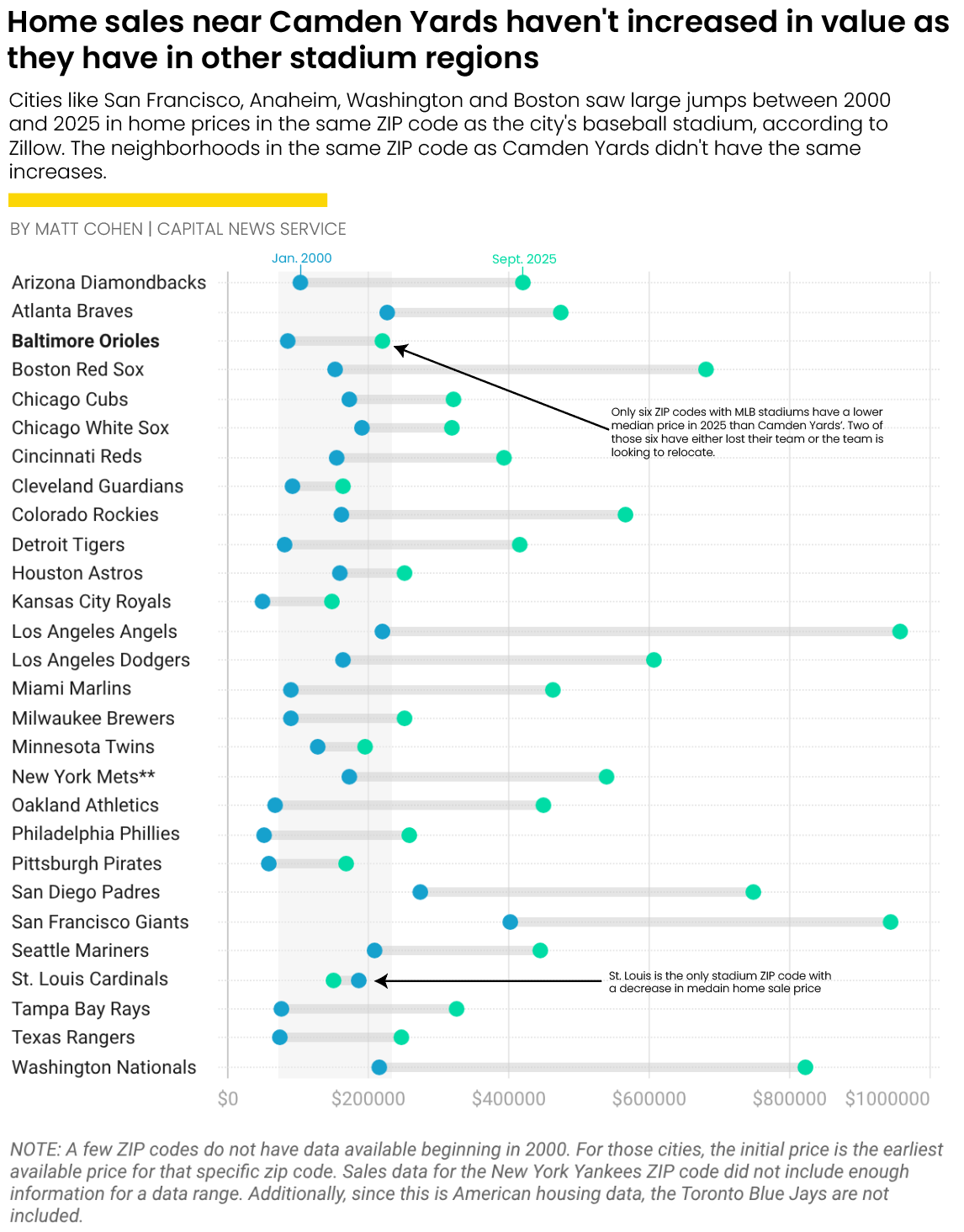
According to data from Zillow, the median home sales price in the same ZIP code as Camden Yards had the seventh-smallest increase among 26 venues with complete data since 2000.
Baltimore is among the cheapest cities to live in with a professional baseball team. As of September 2025, only five other cities have a lower median home price in the same ZIP code as a baseball stadium as Baltimore. Four of those five other cities also have downtown stadiums.
According to the Convention Center’s 2025 report, the facility has operated at an average loss of $12.8 million between the 2020 and 2024 fiscal years.
“You go walking around that area when there’s not a convention in town or when there’s not a baseball game in town, which is more often than not the case, and you go walking along those blocks and it's pretty desolate,” McComas said. “There’s not much economic activity going on there. It’s a bit of a ghost town.”
The blocks between Camden Yards and the harbor contain hotels, a federal courthouse and office buildings. There are few small businesses and only a handful of restaurants there.
“If there had been more of a cohesive vision for connecting the Harborplace pavilions to other areas downtown, then Harborplace might have had a better chance at succeeding,” McComas said. “But it certainly didn’t help that it was very closely connected to these spaces that were vacant a large part of the time.”
Since the riots that followed the killing of Freddie Gray in 2015 and the COVID-19 pandemic that started in 2020, data shows downtown Baltimore's businesses have continued to struggle. In Baltimore’s primary downtown neighborhoods, the total number of available jobs has either decreased or flatlined, according to data from the Baltimore Neighborhood Indicators Alliance at the University of Baltimore’s Jacob France Institute.
Nor are new businesses coming in. The number of new businesses opened within the prior four years in downtown Baltimore has decreased significantly since 2015. So too has the total number of businesses per 1,000 downtown residents, according to the BNIA.
Part of the decline has to do with a shrinking number of residents in Baltimore itself — Baltimore reported a decrease in population every year between 2014 and 2023. In March, Baltimore announced that its population grew the previous year for the first time since 2014.
The National Aquarium, another major downtown anchor, has seen an increase in attendance revenue since 2017, according to its annual publicly released financial statements. But adjusted for rising entry prices ($49.95 for an adult ticket), the aquarium is, on average, selling fewer standard adult tickets.
Over time, the Orioles have shown an interest in improving the district around the stadium.
In 2023 — before the Orioles signed their latest lease and before current owner David Rubenstein bought the team from John Angelos in 2024 — The Sun reported that Orioles officials visited the entertainment district around the Atlanta Braves’ Truist Park, which opened in 2017 and is surrounded by luxury apartments, hotels, restaurants, and bars. It is also located about 13 miles from downtown Atlanta. The Braves are part of a trend of new stadiums that have included newly constructed businesses outside the gates, too.
ESPN reported the Braves' “village-style development” has been “an unqualified success” with the team’s valuation having increased since its construction. But former Cobb County Commission Chairman Tim Lee — who led the deal that put up about $300 million in public funding for the Braves — was handily defeated in his 2016 reelection campaign, with the unpopular stadium deal serving as a major factor for some voters.
This is where Baltimore finds itself as Scott plans the next stage of this generation’s downtown revitalization. But economists stress caution. Bradbury believes using any public subsidies — as Maryland is doing — for stadiums, and even for stadium entertainment districts, is wrong.
“Why is it that we keep making these mistakes over and over?” Bradbury said.